We at Swan Fly Estonia are thrilled to extend a warm welcome as you embark on your journey to pilot the Boeing B777 for CMA CGM. This venture offers an extraordinary chance to excel, and we look forward to kicking off your type rating. We are pleased to begin a strong partnership with CMA CGM by conducting your training.
As the initial type rating will be organized by our Approved Training Organization (ATO), we wish to provide you with essential details regarding procedures, primary contacts, and vital information about the various training locations. This information is available in the following pages.
⚡Quick Access to Resources
ℹ️ Training Details
🧑🎓 Training Details
The Initial type rating with Swan Fly Estonia comprises two main components:
Theoretical Training
Practical Training
🛫Theoretical Training
The theory segment begins with Computer-Based Training (CBT), accessible online at your convenience. It's advisable to refer to the FCOM Systems description as a supplementary resource. While training schedules offer a suggested timeline, you are free to progress at your own pace, ensuring completion of the CBT prior to the theoretical classroom sessions. Access credentials for the CBT provided by CMA CMG.
📖 Theoretical classroom sessions are designed for in-depth discussions on CBT and aircraft systems. To further your preparation, the following manuals and chapters are recommended:
FCOM - Limitations
FCOM - Normal Procedures
FCTM - Familiarization with setup
QRH - Memory Items
QRH - MAN - Maneuvers
MEL - Introduction
During this phase, you'll gain access to a Boeing B777 question bank, featuring extensive questions to deepen your understanding of aircraft systems. The culmination of theoretical sessions includes a systems test, requiring a minimum passing score of 75%. Rest assured, we are committed to ensuring you are thoroughly prepared for the final theoretical test. We will additionally provide you with a link to our platform which includes all necessary documentation for the training in the upcoming days.
✈️ Practical Training
This phase involves 8 sessions, and includes a comprehensive training syllabus covering briefing and simulator training flights. The final check as well as ZFTT will be scheduled after conducting your OCC. "Study Items" are provided for each session to facilitate your preparation, equipping you with the necessary knowledge for each training milestone.
In total, the initial sessions will utilize an FPT (Flat Panel Trainer), followed by 8 Full Flight Sessions in preparation for the Skill Test (LST) and Zero Flight Time Training (ZFTT).
📧 Contact Details
For general inquiries related to training planning or any concerns, please contact Martin Stephan Heun. For specifics related to the B777, especially during the theoretical training phase, Patrick Pflanz will be your point of contact. Questions regarding practical training, including individual sessions, should be directed to Alex Bakkers.
Feel free to reach out to the designated contact person as per your needs. Thank you.
Martin S. Heun CTKI/ Director/ Trainings Manager B737/777 TRI/TRE +49 160 377 8694 m.heun@swan-fly.com
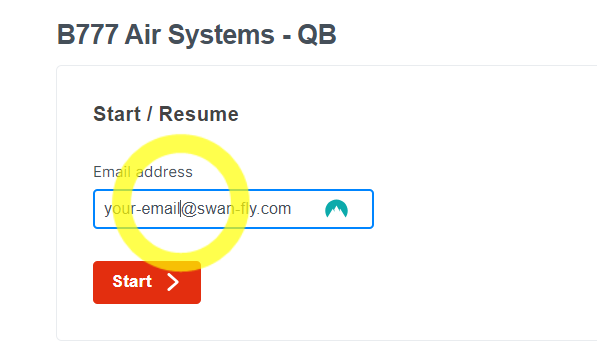
Create a username for your test by inserting your email:
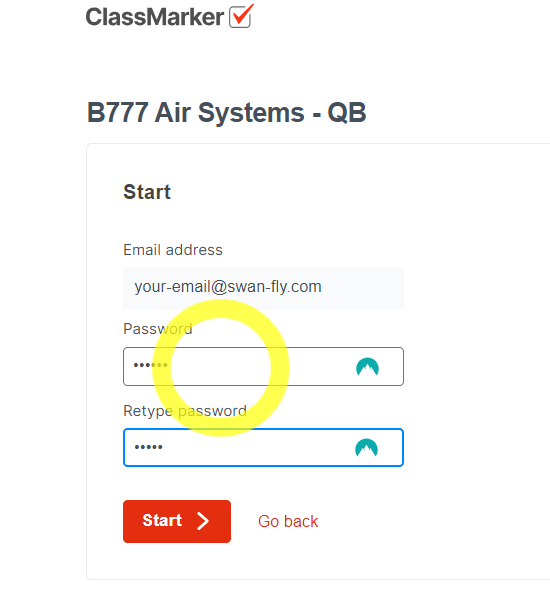
Choose a password for your username:
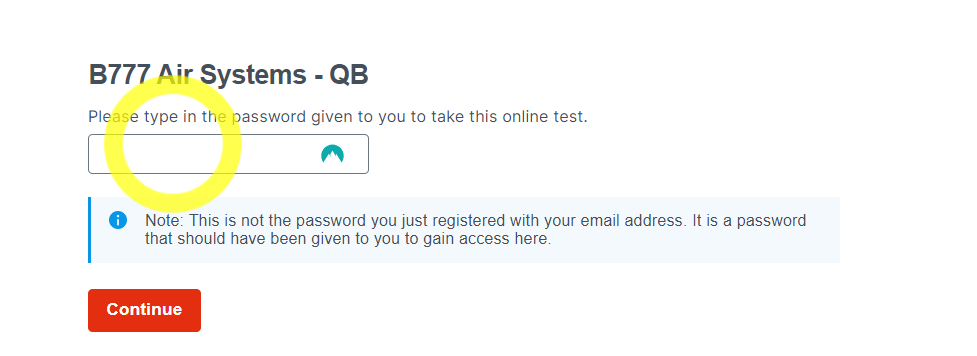
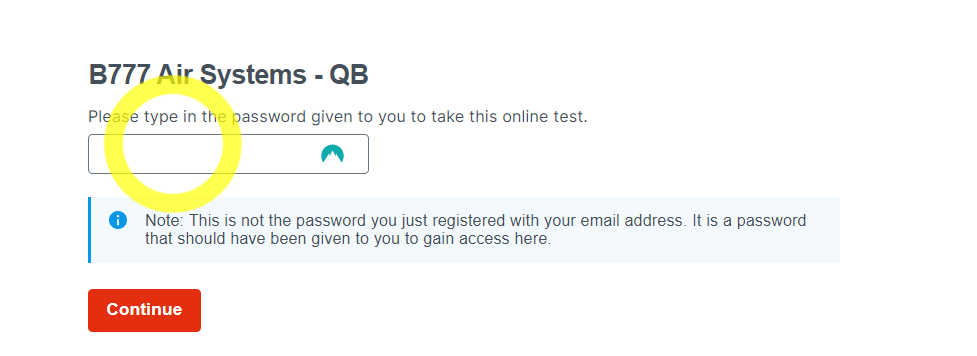
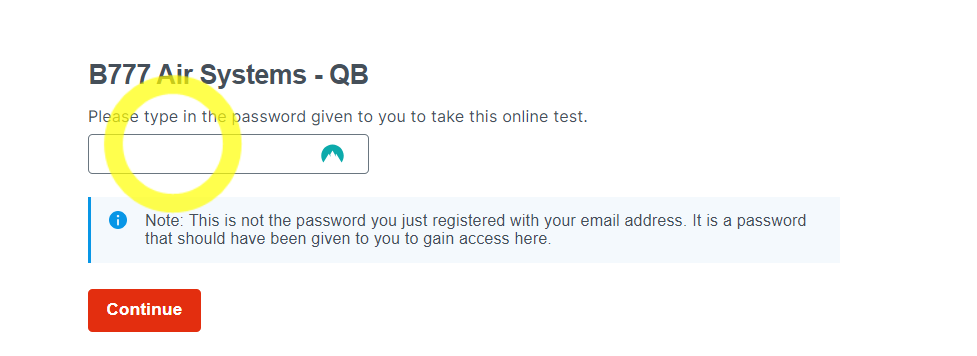
On the next page, enter the password for your test, which is provided on WebCity specifically for the relevant test:
Please confirm your email once more and click 'Start':
On the next page, you will find instructions and information about the test. Tests linked to the question bank are not monitored and a non-passed result is not recorded in the system. However, you are still required to complete all the tests.
Is the CBT alone adequate preparation for the exam?
To supplement the CBT provided by CPaT, we are providing access to an additional question bank. This question bank has proven to be a valuable resource for preparation in previous type ratings across various aircraft types. Our experience shows that if you diligently work through these questions, you will be well-prepared to pass the system test.
Is it possible to assess our daily preparation progress for exam?
In terms of checking your preparation level daily, the question bank and other training materials we provide do allow for regular self-assessment. This means you can indeed monitor your progress and understanding on a day-to-day basis, ensuring that you are consistently building your knowledge and confidence in the material.
Is it possible to get the question bank in a pdf file?
Unfortunately, due to copyright concerns, we are unable to publish or provide the question bank as a single open file. We can only make it available within the protected Classmarker environment. However, if you have any specific questions or if there are other ways we can help you prepare for the theoretical exam, please do let us know.
TRI/SFI Training:
Practical Training
Where can I find the completion Standards?
Refer to the file name: 01. XXXXTRISFI - GRADING SYSTEM within the B747 TRI/SFI Manual (Exercises) above
How should I prepare for the Training Session?
Make sure before before the session you have read and prepared the briefings and training mission from the SYLLABUS SESSION files above.
❓ Frequently Asked Questions (CMA CGM Procedures)
📖
CMA Procedures Clarification:
OM-B 3.7.2 Memory Items - Stationary on Ground:
Is the engine fire switch intended to be pulled by the First Officer as per the example provided?
Answer: Yes, on ground, with NO confirmation, the last action (Fire switch) is taken by FO. In flight, the first 2 actions are taken by PF (with confirmation), the remaining 2 by the PM.
OM-B 2.3.4 FMC Takeoff Data Entry Procedure
Is this procedure intended to be executed differently from a Read & Do?
Answer: Once you have crosschecked the takeoff performances (with the 2 OPT’s), and received and validated the loadsheet, you start this FMC takeoff procedure. Captain is making the entries in CDU and on MCP. You do not do this procedure read and do. The captain starts entering the ZFW from the loadsheet, and continues with the assistance of the FO, filling all the CDU pages, then does the MCP.
OM-B 2.3.7 Before Start Procedure
FCOM NP21.21 Before Start Procedure:
Should all steps in OM-B 2.3.7 be executed immediately following the "Exterior Doors" step?
Answer: YES.
OM-B 2.3.11 Departure Runway or Takeoff Data Change
OM-B 2.3.11 Departure Runway or Takeoff Data Change
Should this procedure be executed as a Read & Do?
Answer: Yes
OM-B 2.5.1 Before Taxi Procedure
OM-B 2.5.1 Before Taxi Procedure
At what point should the Runway Turnoff Lights be turned off, such as at 10,000 feet?
Answer: YES, at 10.000 feet. A new OMB revision will be published next week, with that information. At 10.000 feet, all lights OFF, seat belt (normally) OFF.
OPT Access
Access to Performance Tools:
Is there any chance to get some insights on the performance tool used? Most probably you also use OPT?
Answer: YES, OPT.
FMA Callouts
FMA Callouts and Procedures
When are FMA callouts initiated?
Answer: By the PF, when there is a change. And always acknowledged/confirmed with the word ‘CHECKED’ by the PM
Procedure Trigger Items
FMA Callouts and Procedures
What specific wording triggers the Before Start/Taxi Items?
Answer: The before start items begin when the captain is asking the ground engineer to pressurize the hydraulics. Also the transponder must be set at this stage. Before start checklist must be pushed.
Before taxi items begin when the pushback is completed. Before taxi checklist must be pushed.
When ATC gives taxi clearance, PM lights ON AND pushes the checklist switch. Before takeoff checklist will be performed, later during taxi, after wx/terrain selection.
When airborne, when the PM retracts the flaps to UP, the PM also pushes the checklist swith.
Checklist Response - Trim Settings
FMA Callouts and Procedures
Is the First Officer expected to respond to trim settings during the Before Start procedure?
Answer: No
Checklist Response - Role Response
Procedures/Checklists
During normal checklists where responses are required from both crew members, is the side of the aircraft (left/right) also called out? For instance, in the preflight checklist, would it be stated as: "OXYGEN TESTED 100% LEFT"?
Answer: This is not applicable. So no LEFT/RIGHT has to be mentioned.
Recall - Response
FMA Callouts and Procedures
Should the First Officer announce "Recall" before the captain confirms "Checked"?
Answer: Yes
Recall - After Flight Control Check
Procedures
Shall the recall button only be pressed after the flight control check has been completed?
Answer: According to the FCOM, yes.
Departure and Emergency Briefing
Briefings
Is the emergency briefing prior to departure conducted in a "role play" manner, or is it exclusively presented by the Pilot Flying (PF)?
Answer: The Captain begins his briefing with his items: Rejected Take-Off and the conditions to reject. The First Officer will brief his items to monitor all actions, call out his items, and notify ATC. Then, the items beyond V1 are briefed by the Pilot Flying. The normal briefing will follow. Threats are asked by the Pilot Flying to the Pilot Monitoring, who will then respond. The departure briefing should be kept rather short.
Departure and Emergency Briefing
Briefings
Who does the Emergency Briefing for RTO and whom for beyond V1?
Answer:
The Captain starts the emergency briefing up to V1, including actions after a rejected takeoff (RTO) such as evacuation. The Pilot Flying (PF) briefs from V1 onwards.
Non-ILS Callouts
Callouts
For the callout "approaching bearing," does this apply to all non-ILS approaches, including RNPs? If applicable to RNPs, could you specify the reference used in these scenarios?
Answer: This callout is not applicable
Pilot Flying Duties
Procedures
Can you confirm that the designated PF (either Captain or First Officer) is responsible for taxiing the aircraft both before departure and after the flight?
Answer: The PF is always responsible for taxiing, which means the FO can also taxi, whether taxiing out or in
CDU Input Change Execution
Procedures/Checklists
After engine start, should all CDU entries be confirmed before execution?
Answer: Yes, all entries should be confirmed. See OMB 2.1.4
EO-SID
Procedures/Checklists
If there is a disagreement between the EOSID FMC and OPT, does the OPT govern?
Answer: There is no EOSID in the FMC as with other Operators. Always the OPT output needs to be used. (OMB Page 78)
CDU Preflight
Procedures/Checklists
Who performs the CDU preflight setup: the Pilot Flying (PF) or the Pilot Monitoring (PM)?
Answer: by the person not doing the walkaround after he/she has completed his/her preliminary preflight procedure.
Hydraulic Pressurisation
Procedures
Shall the First Officer wait until all HYD Pumps are verified to be extinguished during the Before Start Setup?
Answer: According to the FCOM, yes. Verify that all FAULT lights are extinguished (All extinguished except 1 primary center pump (load shed))
Change of Controls
Procedures
When do the roles from First Officer to PF/PM change. And who is taxiing?
Answer: Role change at RT call just before parking brake release. The PM asks for taxi, and the FO as PF taxies the airplane. At shutdown, the parking brake is again the handover moment.
Flap Retraction
Procedures
During flap retraction, does the PF call 'Flaps' and the PM call 'Speed checked' before moving the lever?
Answer: Yes - see FCOM.
Descent Setup
Procedures
For the descent setup, should the pilots hand over control for setup in the CDU, and after setup, take control again and brief from the CDU/FMS?
Answer: Yes. When setting up the approach, prolonged head-down time prevents monitoring and flying the plane. Handing over control is pragmatic and is in accordance with CMA CGM SOPS.
ILS Identification
Procedures
Should the approach call 'ILS identified' be made when the identifier is tuned and the indication is on the correct side?
Answer: Yes.
1000’ call
Procedures
Should the standard call '1000' be followed by the PM stating 'MA altitude set' and the PF responding 'Checked'?
Answer: Correct. At 1000 feet, call 'Stable' (or 'Not stable'). Missed approach altitude set. This is good SOP as it effectively addresses the 2D approach case for setting the missed approach altitude at MDA + 300 feet, as most 2D approaches have minima of approximately 600-700 feet above ground, which perfectly coincides with the 1000 feet call.
Go-Around
Procedures
During a go-around, should the PF call 'Go around - set thrust,' the PM respond 'Thrust set,' and the PF then call 'Flaps __'?
Answer: Yes.
APU after Landing
Procedures
When shall the APU be started after landing?
Answer: After landing: APU usage is based on simple crew judgement. Start the APU before turning onto the stand unless the taxi is very short; in that case, start it during the after-landing procedure. APU start should be delayed until 2 minutes before reaching the parking position. See OMB 2.14.1
Shutdown and Door Disarm
Procedures
During shutdown, should the Captain perform fuel control cutoff, then disarm the doors, and finally switch off the pumps and complete the shutdown procedure? Also, who will disarm the doors?
Answer: This is correct procedure, but the FO will disarm the doors according to OMB 2.14.3. The Captain may delegate the task of disarming the doors to any qualified person. - see also further OMB 2.14.4
Fire Eng on Ground
Procedures
During a non-normal situation on the ground involving an engine fire indicated by EICAS without memory items, should the procedure be to shut down the engine and use the fire bottle according to the NNC Fire Engine checklist? Generally, should engine non-normal procedures on the ground be handled by the Captain using memory items, except for the Engine Fire switch? Inflight, should memory items be handled by the PF up to the Fuel Control switch?
Answer:
When handling an un-annunciated engine fire on the ground, use the ECL or checklist. The second fire bottle should never be activated from memory; it should always be referenced either from the Fire Engine checklist or the Evacuation checklist. Ensure to check OMB 3.2.4 Engine Fire SOP.
For engine non-normals (NN) on the ground:
The Captain is responsible for A/THR, thrust levers, and fuel control switches.
In the air:
The area of responsibility shifts such that the PF handles A/THR and thrust levers, while the PM manages the fuel control switches.
Areas of Responsibility
At CMA-CGM, the areas of responsibility are
🦺Safety Occurrence Report
🦺Safety Occurrence Report
Do you need to report an occurrence? Use this Link:

 Made with Bullet